

Design and Construction Report staff writer
New York City will provide $29.2 million to New York University (NYU) to construct a 23,000-sq. ft. Quantum Fabrication Facility at 770 Broadway in Manhattan, supporting the development of quantum technology and related workforce training programs.
The facility, known as QFab, is backed by an additional $255 million from NYU for construction and 10 years of operations. It is expected to open in 2030 and provide researchers, students, startups and established companies access to specialized equipment for manufacturing and testing quantum chips and components.
“This first-of-its-kind agreement will give the city board seats to shape the future of the quantum industry and a stake in the new technologies that emerge from the lab, making sure that all New Yorkers see the profits and progress from quantum technology, not just the wealthy few. We are building a city where economic justice doesn’t come at the expense of innovation.”The facility will include specialized cleanrooms, cryogenic systems and advanced manufacturing and testing equipment. It will support the development of quantum devices and help companies move prototypes toward commercial production.
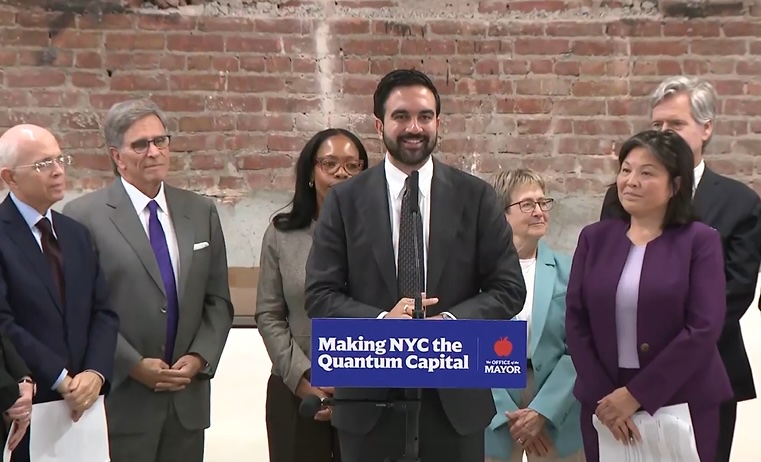
Mayor Zohran Kwame Mamdani, Deputy Mayor for Economic Justice Julie Su and New York City Economic Development Corporation (NYCEDC) president and CEO Anthony Shorris announced the funding.
The project includes a public-private agreement giving the city three seats on QFab’s Executive Advisory Board. The city will also receive 15 per cent of NYU Central Administration’s proceeds from intellectual property created at the facility using equipment funded by the city. Eligible proceeds include equity, royalties, milestone payments and patent licensing revenue.
“This first-of-its-kind agreement will give the city board seats to shape the future of the quantum industry and a stake in the new technologies that emerge from the lab, making sure that all New Yorkers see the profits and progress from quantum technology, not just the wealthy few,” Mamdani said in a statement. “We are building a city where economic justice doesn’t come at the expense of innovation.
”The arrangement is intended to give the city a role in shaping the facility’s direction while allowing the public to share in financial returns generated by technologies developed with public funding.
QFab is expected to reach more than 35,000 New Yorkers during its first decade of operation, including more than 5,000 students through undergraduate and graduate programming, summer workshops, internships and certificate programs.
NYU will work with the City University of New York (CUNY) and New York City Public Schools to provide access to laboratory equipment, technical training and educational programs intended to prepare students for jobs in the emerging quantum sector.
The facility is projected to incubate nearly 50 companies and provide services to another 50 newly formed startups. NYU also plans to offer technician training, internships, boot camps and certificate programs to support workforce development.
NYU president Linda Mills said the facility would connect the university’s research operations with students and businesses across the city.
“New York City-based start-ups and companies will have access to cutting-edge fabrication and materials found in few other cities,” Mills said.
Dr. Juan de Pablo, NYU’s executive vice-president for global science and technology and executive dean of the NYU Tandon School of Engineering, said the facility would support employment opportunities for technicians, fabricators and engineers as well as researchers with advanced degrees.
The city’s contribution is part of a broader public-private funding package of approximately $284 million. U.S. Sen. Chuck Schumer said he had secured federal funding for NYU to purchase state-of-the-art quantum technology equipment, complementing the city’s contribution.
Quantum technology uses principles of quantum mechanics to develop new computing, sensing and communication systems. The technology has potential applications in fields including health care, life sciences, finance, semiconductors and advanced manufacturing.
The project is intended to strengthen New York City’s research and technology sector while expanding access to specialized facilities and training for students, entrepreneurs and businesses.

